Which Wavelength Does What: A 297–1280nm Map
A wavelength-by-wavelength map of sunlight — UVB (297nm) to deep infrared (1280nm) — what each band reaches and does, cited. Why red+NIR is only half the spectrum.
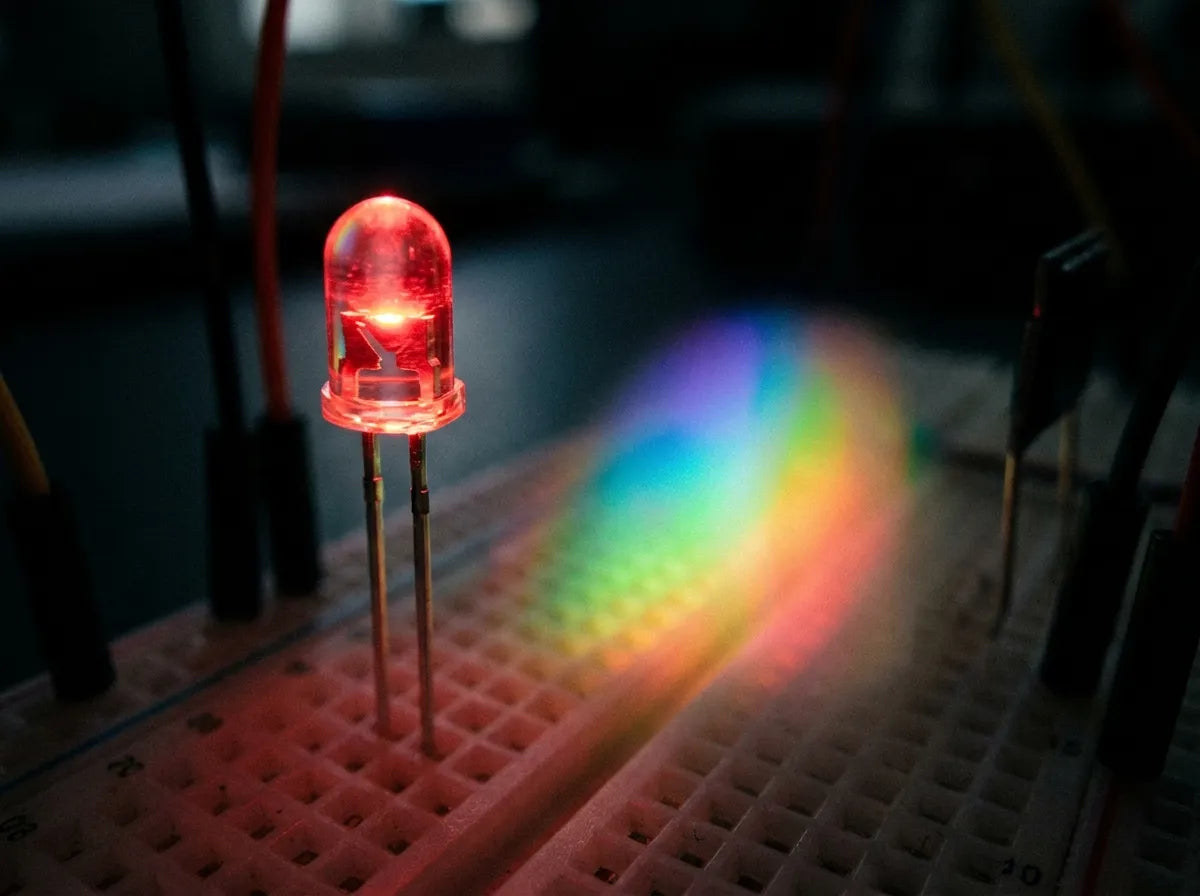
Each band of sunlight does a different job, set by how deep it goes. UVB (~297nm) makes vitamin D at the surface; UVA (~365–380nm) releases nitric oxide and is read by UV photoreceptors; red (~630–670nm) and near-infrared (~770–1070nm) power mitochondria at increasing depth; deep infrared (~1280nm) brings gentle warmth. Red+NIR is only half the map.
Most of the light industry answers every question as if human biology ran on two bands — red and near-infrared. It doesn't. Sunlight is a continuous ribbon, and each part of it carries a different signal, set by how deep that wavelength reaches and which molecule absorbs it. Here is the whole ribbon mapped, band by band, from the ultraviolet front to the deep-infrared edge.
Once you see the map, the marketing word "full spectrum" stops being vague. It means carrying the breadth of the ribbon — not two rows of it. We start where every map should: why wavelength decides everything in the first place.
01 · The PrincipleWhy does wavelength decide everything?
A wavelength (measured in nanometres, nm) is the "colour" of light, and it sets two things at once: how deep the light reaches into tissue, and which molecule absorbs it. Shorter wavelengths (UV) are absorbed at the surface; longer wavelengths (red, near-infrared) reach progressively deeper before being absorbed (Anderson & Parrish, J Invest Dermatol, 1981, PMID 7252245; Meinhardt et al., J Biomed Opt, 2008, PMID 19021357; Salehpour et al., 2019, PMID 31553265). Because depth and target both shift with wavelength, you cannot substitute one band for another — a red diode physically cannot do a UVB diode's job, and vice versa. That is the whole reason "full spectrum" matters: the sun is a continuous ribbon, and each part of it carries a different signal.
02 · The MapThe full 297–1280nm map
This is the table the rest of the industry doesn't publish, because most devices only occupy two rows of it. Each band below is mapped to what the research associates with it (wellness framing — these are studied effects, not medical claims):
| Wavelength | Band | Reaches | What the research associates with it |
|---|---|---|---|
| ~297nm | UVB | Epidermis (surface) | The only band that makes vitamin D in skin; previtamin-D3 synthesis peaks 295–300nm (MacLaughlin, Anderson & Holick, Science, 1982, PMID 6281884). Window glass blocks it (Webb, DeCosta & Holick, J Clin Endocrinol Metab, 1989, PMID 2541158). |
| ~365nm | UVA | Upper dermis | Mobilises skin nitric oxide → vasodilation, associated with lower blood pressure, independent of vitamin D (Liu, Feelisch & Weller, J Invest Dermatol, 2014, PMID 24445737). |
| ~380nm | Deep UVA / near-UV | Dermis | Read by the UV photoreceptor OPN5 (neuropsin), peak sensitivity ~380nm (Kojima et al., PLoS One, 2011, PMID 22043319); studied for circadian and ocular signalling (Buhr et al., PNAS, 2015, PMID 26392540; Nguyen et al., Nat Cell Biol, 2019, PMID 30936473) and violet-light myopia control (Torii et al., EBioMedicine, 2017, PMID 28063778). |
| ~405nm | Violet (visible) | Surface | Excites endogenous porphyrins → ROS, studied for skin clarity / antimicrobial effect (Maclean et al., Appl Environ Microbiol, 2009, PMID 19201962). Used in the redPINK mask. (Note: visible light can drive pigmentation in deeper skin tones — Mahmoud et al., 2010, PMID 20410914 — so it's dosed, not maximised.) |
| ~460–480nm | Blue | Surface/retina | The melatonin-suppression band — action spectrum peaks ~460–464nm (Brainard et al., J Neurosci, 2001, PMID 11487664; Thapan et al., J Physiol, 2001, PMID 11507083); read by melanopsin ~480nm (Hattar et al., Science, 2002, PMID 11834834). Powerful for daytime alerting; the band to block at night. |
| ~630–660nm | Red | A few mm | Absorbed by cytochrome c oxidase in mitochondria → supports ATP; studied for skin collagen and tone (Karu & Kolyakov, Photomed Laser Surg, 2005, PMID 16144476; Barolet et al., J Invest Dermatol, 2009, PMID 19587693; Avci et al., 2013, PMID 24049929). |
| ~670nm | Deep red | A few mm | On the cytochrome-c-oxidase absorption shoulder; studied for mitochondrial membrane potential, including retinal models (Hamblin, Photochem Photobiol, 2018, PMID 29164625; Begum et al., PLoS One, 2013, PMID 23469078). |
| ~770–810nm | Near-infrared | Deeper (muscle) | Reaches below the skin; the most-studied NIR band for muscle, recovery and transcranial work (Salehpour et al., 2019, PMID 31553265; Ferraresi, Hamblin & Parizotto, 2012, PMID 23626925). |
| ~940–1070nm | Near-infrared | Deeper still | Within the tissue "optical window"; supports the same mitochondrial mechanism at depth (Karu & Kolyakov, 2005, PMID 16144476). |
| ~1280nm | Deep infrared | Surface warmth | The warm far edge of sunlight — gentle thermal/comfort band closing the spectrum. |
What each band of sunlight reaches and is associated with — the whole ribbon, not two rows of it.
03 · The MechanismWhat does cytochrome c oxidase have to do with the red bands?
The red and near-infrared rows above share one mechanism. Red/NIR is absorbed by cytochrome c oxidase, an enzyme in the mitochondria, where it is thought to dissociate inhibitory nitric oxide and briefly restore electron transport, supporting cellular energy (ATP) production (Karu & Kolyakov, 2005, PMID 16144476; Hamblin, 2018, PMID 29164625). This is photobiomodulation — the science term for red-light therapy. It's a genuine, well-mapped pathway. It is also, importantly, only the red/NIR part of the story — the UV and visible bands above act through completely different receptors and molecules.
04 · The GapSo why do most panels only cover two of these rows?
Because UV and visible bands are harder and costlier to engineer safely, almost every red-light panel on the market lives in just the red and near-infrared rows — typically 2–6 wavelengths, all above 600nm. That is a real, useful slice of sunlight. But look at the map: it is the warm back half only. Everything that makes vitamin D, mobilises nitric oxide, or is read by the body's UV and circadian photoreceptors sits in rows a red-only device never carries. This is the full-spectrum thesis in one image — half the sun isn't enough.
05 · The ThesisCopy the sun, not a slice of it
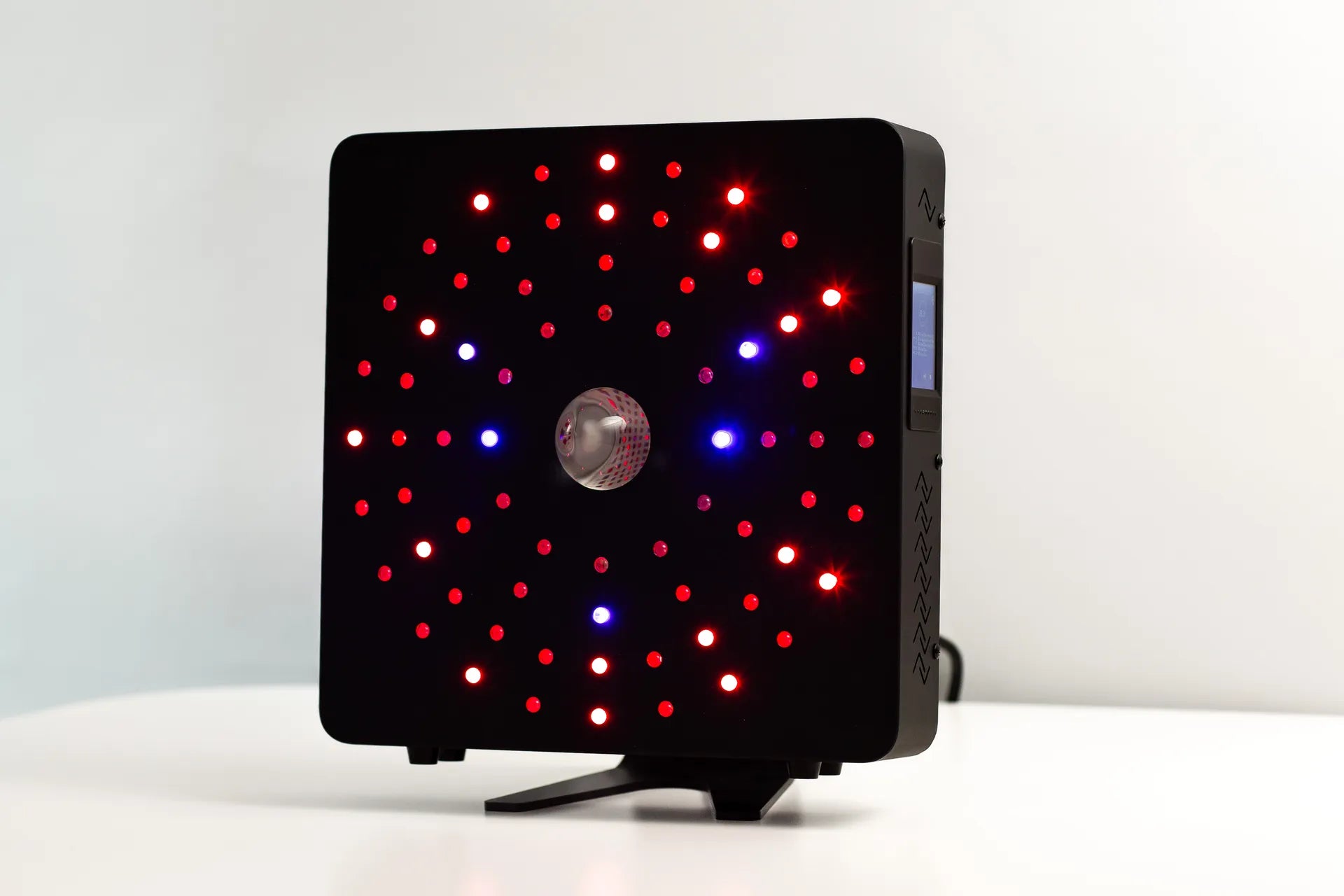
Here is the design conclusion the map forces. If each band does a distinct job that no other band can stand in for, then reproducing the light environment — not just the cellular-energy bands — means carrying the breadth of sunlight. That is the specific brief REDelios ONE was built for: ten wavelengths from 297 to 1280nm — UVB (297), UVA (365, 380), red (660, 670), near-infrared (770, 810, 940, 1070) and deep infrared (1280) — chosen to present the whole map above in measured doses, the way a bright morning does, rather than two rows of it. Every wavelength claim we make is backed in the research library, and each term here is defined in the glossary. If all you need is the red/NIR rows, a focused panel may suit you fine — just read the map and know which rows you're buying.
The UV bands above are real signals that deserve real respect. In a full-spectrum device they are intended for measured, time-limited, controlled doses — never to tan, never to burn. Brief and well-timed is the point. If you are pregnant, photosensitive, on photosensitising medication, or managing a skin or autoimmune condition, speak with a qualified professional before adding any UV-containing light.
REDLIGHT.DOCTOR provides wellness and educational information, not medical advice, diagnosis or treatment. Wavelengths and device specifications are stated as engineered. Studies referenced describe research findings and are not claims that any device treats, cures or prevents disease. Consult a qualified professional for individual guidance.