Vitamin D in a European Winter: The Months Your Sun Can't Help
For much of the year, most of Europe sits under a sun too low to make vitamin D. Here is why winter daylight goes quiet — and what actually helps.

Above roughly 35°N — essentially all of Europe — the winter sun sits too low in the sky for UVB to reach the ground, so your skin makes little or no vitamin D outdoors from about October to March. Through those months you rely on body stores, diet, a supplement, or indoor full-spectrum light with a measured UVB band.
There is a quiet fact behind a lot of European winters: for several months, standing in the midday sun does almost nothing for your vitamin D. The light still feels bright. The chemistry simply isn't there.
Vitamin D is the one nutrient our bodies are built to make from light rather than food. But only one narrow band of sunlight — UVB, around 297nm, the peak wavelength for vitamin-D synthesis in skin — triggers it. And UVB is exactly the part of the spectrum that a low winter sun never delivers to the ground.
The MechanismWhy can't winter sun make vitamin D?
It comes down to the angle of the sun. In winter, the sun stays low on the horizon, so its light enters the atmosphere at a steep, glancing angle. That means each ray travels a much longer path through the ozone layer before it reaches you — and ozone absorbs UVB strongly. The longer the path, the more UVB is filtered out before it ever lands on your skin.
Visible light and warmth still get through, which is why a winter day can look and feel sunny while making no vitamin D at all. The deciding factor is the solar zenith angle: when the sun climbs high in summer, UVB reaches the ground; when it stays low in winter, that band is stripped away. In the classic measurements, skin in Boston (42°N) made no previtamin D3 from November through February, and in Edmonton (52°N) the dead period ran from October through March.
A winter noon can be blindingly bright and still carry no usable UVB. Brightness is not the same as the wavelength your skin needs.
By LatitudeWhich months are a “vitamin-D winter” where you live?
The further north you live, the longer your “vitamin-D winter” — the stretch when outdoor UVB is too weak for meaningful synthesis. Across Europe this ranges from almost none at the southern edge (~35°N) to many months in the far north. The figures below are illustrative seasonal approximations drawn from European UVB modelling, not a personal forecast — cloud, altitude, skin tone, and how much skin you expose all shift the real number.
| City | Latitude | Approx. no-UVB months |
|---|---|---|
| Berlin | 52°N | Oct – Mar |
| Warsaw | 52°N | Oct – Mar |
| Prague | 50°N | Oct – Mar |
| Vienna | 48°N | Nov – Feb |
| Bratislava | 48°N | Nov – Feb |
| Budapest | 47°N | Nov – Feb |
| Madrid | 40°N | Dec – Jan |
Two patterns stand out. First, the Central European cities where most of our readers live — Prague, Berlin, Warsaw, Vienna, Bratislava, Budapest — all sit deep in the no-UVB band for roughly four to six months. Second, even the southern contrast, Madrid at 40°N, has a short vitamin-D winter; latitude only buys you so much.
The Window MythCan you get vitamin D through a window?
No. Ordinary glass blocks almost all UVB while letting visible light and warmth through, so sitting by a sunny window — or in a car, or a sunroom — feels pleasant but produces essentially no vitamin D. This is why “I get plenty of sun at my desk” doesn't hold up: the one wavelength that matters is filtered out before it reaches you. The same logic applies to most indoor light, including standard red-light panels, which emit only red and near-infrared — no UVB at all.
Pill vs LightWhy isn't a vitamin-D pill the same as light?
A vitamin-D capsule is a useful winter backstop — but it delivers a molecule, where sunlight delivers a signal. Swallowing D3 hands your body the finished compound directly. Sunlight works differently: the skin makes vitamin D from UVB and self-regulates how much, so the same light that builds it up also breaks down any excess. You cannot overdose on vitamin D from light the way you can by over-supplementing.
There may also be more to it than the molecule itself. Vitamin D made in the skin appears to travel a different pathway than the oral form — researchers are studying sun-made compounds such as vitamin-D-sulfate, which the body produces from sunlight but a standard capsule does not. The full picture is still emerging, and none of it is a reason to skip a supplement your doctor recommends.
And UVB never arrives alone. Outdoors it comes bundled with the rest of the solar signal — UVA and the nitric oxide it releases, circadian light cues, the whole visible spectrum — a package a pill simply can't reproduce. So a supplement is a sensible way to keep your levels up through a dark winter, but light is more than a single molecule. That is the case for a measured full-spectrum device indoors: not a replacement for a supplement or a doctor's advice, but a way to bring back more of what daylight actually carries.
IndoorsWhat can you do indoors in a vitamin-D winter?
Three levers are within reach when the sun can't help. Diet carries some vitamin D — oily fish, egg yolks, and fortified foods are the usual sources, though most people struggle to reach useful amounts from food alone. A supplement is the simplest and best-studied option for winter; the right dose and any testing of your levels are a conversation for your doctor, not a guess. And full-spectrum light can supply the part the others can't: a measured UVB band, the way morning sun would.
Here the distinction matters. The vast majority of “red-light” devices emit only red and near-infrared light — wonderful for the cell's energy machinery, but they contain no UVB and make no vitamin D. A true full-spectrum device is the rare format that includes the band sunlight uses.
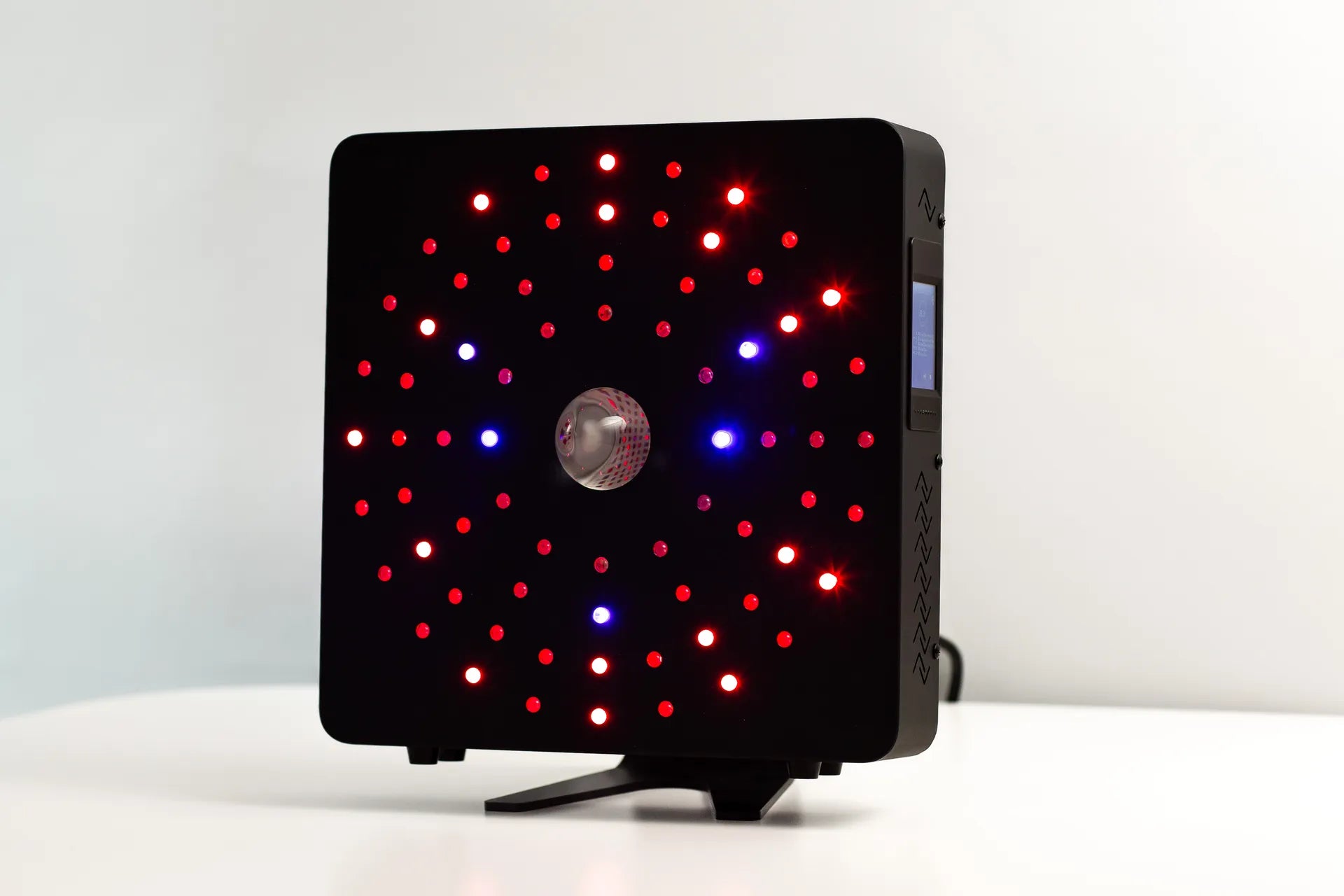
Indoors, three things move the needle: eat the foods that carry it, take the supplement your doctor recommends, and add measured full-spectrum light. REDelios ONE spans 297–1280nm and includes a controlled UVB band (297nm), where most red-light panels emit only red and near-infrared. The clinical thinking behind that breadth sits on our research page, the circadian side is covered in light and sleep, and the underlying terms are defined in the glossary. Any UV is kept measured and time-limited — used the way brief morning sun is, never to tan or burn.
- Webb AR, Kline L, Holick MF. Influence of season and latitude on the cutaneous synthesis of vitamin D3: exposure to winter sunlight in Boston and Edmonton will not promote vitamin D3 synthesis in human skin. J Clin Endocrinol Metab. 1988. PubMed
- O'Neill CM, Kazantzidis A, Ryan MJ, et al. Seasonal Changes in Vitamin D-Effective UVB Availability in Europe and Associations with Population Serum 25-Hydroxyvitamin D. Nutrients. 2016;8(9):533. MDPI / PMC
- Kazantzidis A, et al. Comprehensive Analysis of Seasonal and Geographical Variation in UVB Radiation Relevant for Vitamin D Production in Europe. 2022. PMC
Educational, not medical advice. Vitamin D is discussed for general wellbeing; it is not presented as a treatment for any condition. Decisions about your vitamin D levels, testing, and supplement dose belong with a qualified doctor. Any UV light should be used in a measured, time-limited way — never to tan or burn.