Full Spectrum vs Red + Near-Infrared: Why Half the Sun Isn't Enough
Most panels give you two bands of light. Sunlight gives you the whole spectrum. Here is exactly what red-and-near-infrared-only devices leave out — and why it matters.

Most red-light panels emit only red and near-infrared — 2–6 wavelengths. Sunlight is a continuous spectrum from UV to infrared. A full-spectrum device adds the bands red+NIR-only panels skip — UVB (~297nm, the peak for vitamin D) and UVA (~365 and ~380nm, nitric oxide) — to copy the whole sun, not half.
"Full spectrum" has become one of the most stretched words in the light industry. A device with two red diodes and one near-infrared diode will happily call itself full-spectrum. It isn't. The real solar spectrum is continuous — an unbroken ribbon of light running from ultraviolet, through violet and the visible colours, into infrared. The question is simple: how much of that ribbon does your device actually reproduce?
Red and near-infrared are real, valuable wavelengths. But they are two bands out of many. To understand what a true full-spectrum device adds, you first have to be honest about what an ordinary red-light panel leaves out.
01 · The HardwareWhat does a normal red light panel actually emit?
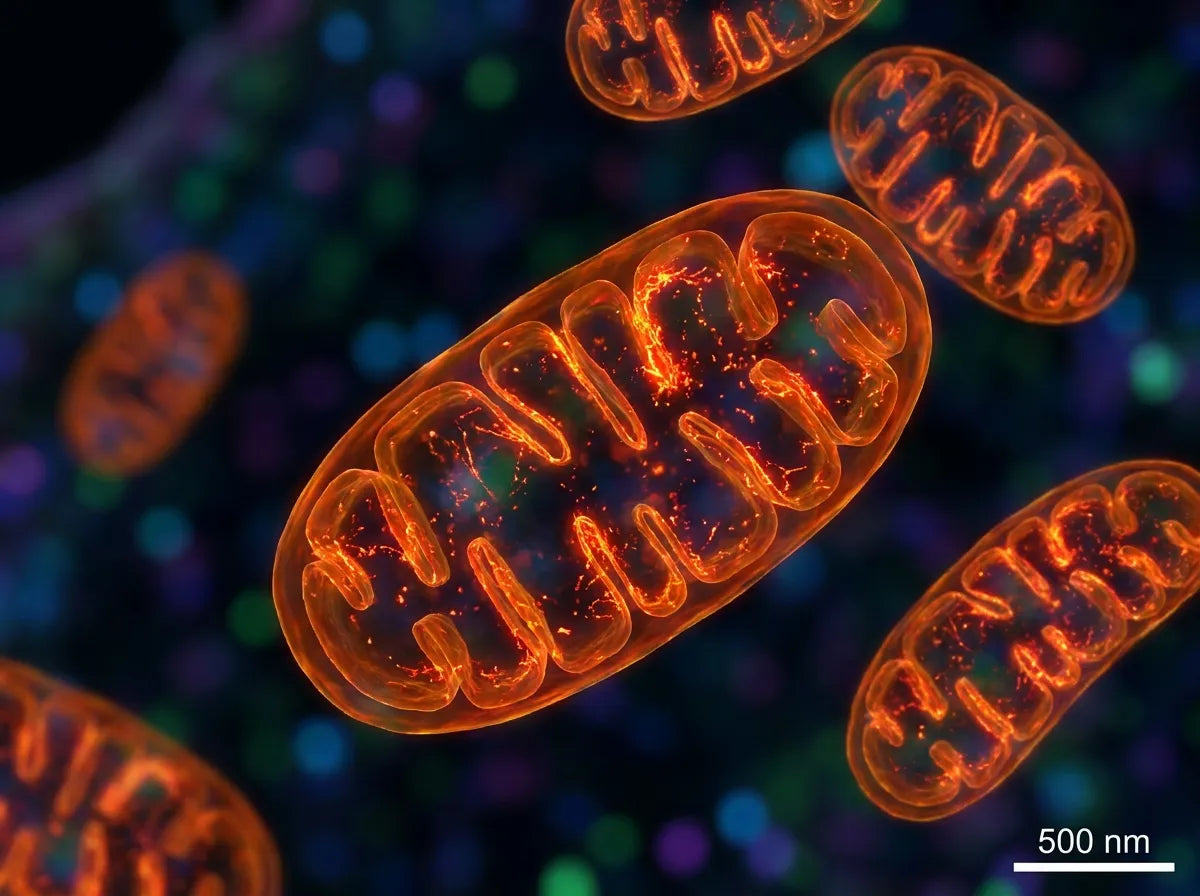
A typical red-light panel ships between two and six wavelengths, clustered in just two regions of the spectrum: red, around 630–660nm, and near-infrared, around 810–850nm. These are well-studied bands. Red and near-infrared are absorbed by cytochrome c oxidase inside the mitochondria, where they help dissociate nitric oxide and support cellular energy production (Karu & Kolyakov, 2005; Hamblin, 2018). That mechanism is genuine, and it is why red and NIR belong in any serious light device.
But notice the geography. Everything those panels emit sits in the visible-red and infrared end of the spectrum — wavelengths longer than about 600nm. Nothing below it. In solar terms, that is roughly the warm second half of sunlight, with the entire short-wavelength front end of the spectrum simply absent.
02 · The GapWhat's missing? (UV)
The missing front of the spectrum is not decorative. Each absent band carries a distinct biological signal that red and near-infrared simply cannot stand in for. Three matter most.
UVB (~297nm) → vitamin D. UVB is the only band of light that makes vitamin D in human skin. MacLaughlin, Anderson & Holick (1982) mapped the action spectrum precisely: previtamin-D3 production peaks between 295 and 300nm, with roughly 65% conversion at 295nm. No red, no near-infrared, no visible light contributes — and ordinary window glass blocks UVB entirely (Webb, DeCosta & Holick, 1989). Vitamin D is associated with a broad set of physiological roles (Holick, 2007).
UVA (~365 and ~380nm) → nitric oxide and circulation. UVA does something different. It mobilises nitric oxide stored in the skin, which relaxes blood vessels. Liu, Feelisch & Weller (2014) showed that UVA exposure releases nitric oxide and is associated with lower blood pressure — independently of vitamin D — and Opländer and colleagues (2009) demonstrated that whole-body UVA mobilises cutaneous nitric-oxide stores. This is a UVA effect, across the 315–400nm band, not a UVB one.
UVA, the deep edge (~380nm) → near-UV signalling. At its long-wavelength edge, around 380nm, UVA borders visible light. This deep-UVA band is studied for skin clarity and, increasingly, as a signal read by recently identified UV-sensitive photoreceptors in the eye and skin (OPN5 / neuropsin, peak sensitivity ~380nm). It is the band almost every red-only panel stops just short of.
03 · The Honest AnswerDoes red light therapy give you vitamin D?
No. This is the question we are asked most, and the honest answer is the important one: red and near-infrared light cannot make vitamin D. Only UVB (~297nm) can. If a device emits nothing below about 600nm — which is true of essentially every red-only panel on the market — it physically cannot drive previtamin-D3 synthesis, no matter how powerful it is or how long you sit in front of it.
Red and near-infrared light cannot make vitamin D. Only UVB can. That is not a flaw in red light — it is the reason a true full spectrum has to add it back.
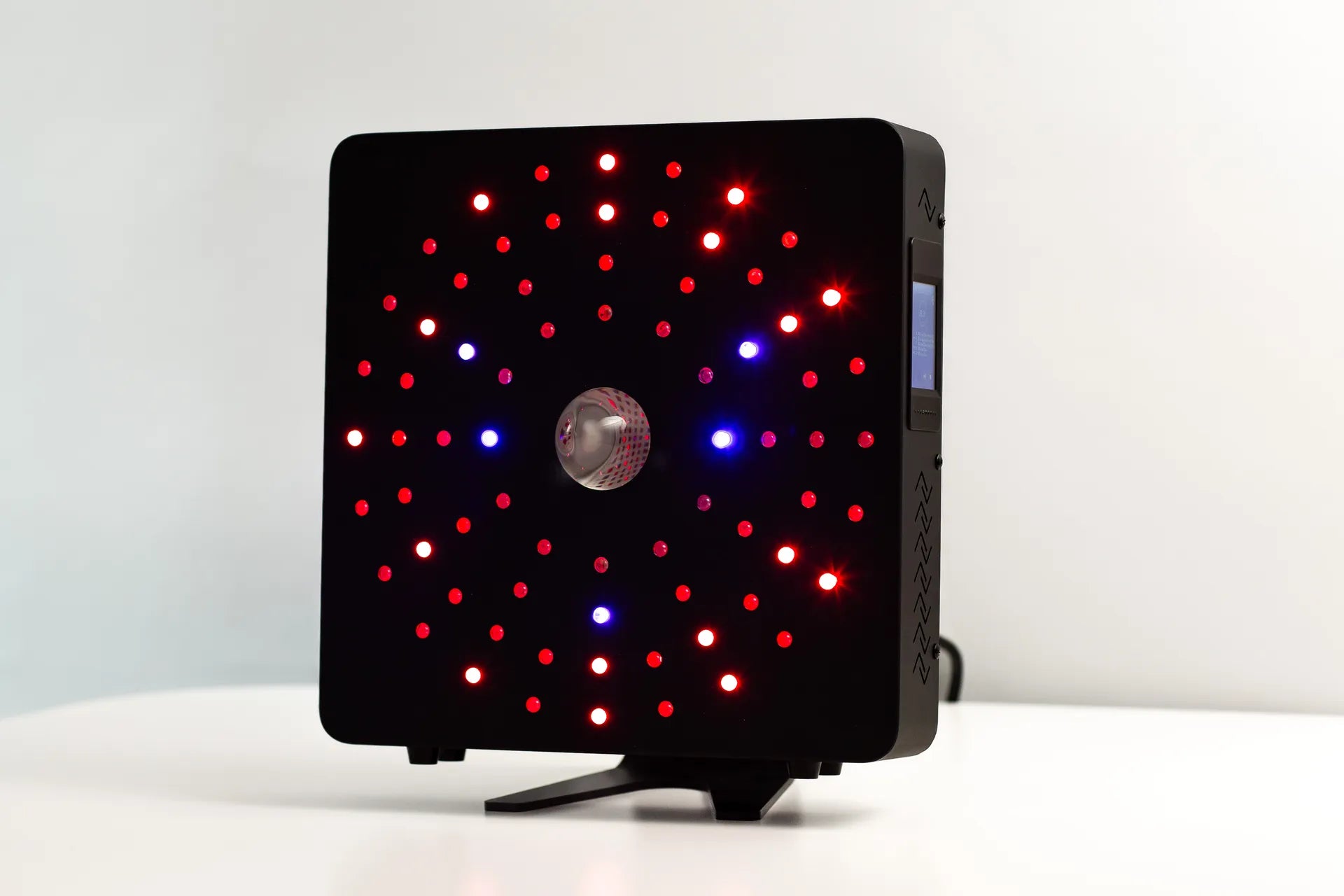
This is exactly why REDelios ONE places a measured band at 297nm — the peak wavelength for vitamin-D synthesis in skin — not to tan, but to restore the one solar signal that red+NIR devices structurally cannot deliver. It sits alongside UVA (365 and 380nm) at the front of a spectrum that then continues through red (660, 670nm) and near-infrared (770, 810, 940, 1070nm) to deep infrared (1280nm): ten wavelengths from 297 to 1280nm, the breadth of sunlight rather than a slice of it.
04 · The European WinterWhy it matters most in a European winter
Above roughly 35°N — which includes all of Central and Northern Europe — the sun sits too low in the sky from about October to March for the atmosphere to pass enough UVB to make meaningful vitamin D outdoors, even at noon on a clear day. For months at a time, the vitamin-D band of sunlight is effectively switched off. Bundle up, add short daylight hours and time spent indoors behind UVB-blocking glass, and a European winter becomes a long gap in the one solar signal that nothing else replaces.
A red-and-near-infrared panel does nothing to close that gap — by design, it never carried the band in the first place. A full-spectrum device is the only home format that can present all three missing signals together, in measured, controlled doses, the way the sun does on a bright morning. It is a supplement to daylight, not a replacement for going outside.
05 · Side By SideFull spectrum vs red light panel — the comparison
| What it carries | Typical red + NIR panel | REDelios ONE · Full-Spectrum™ |
|---|---|---|
| Wavelengths (count) | 2–6 | 10 · 297–1280nm |
| UVB · vitamin D | None | 297nm — the peak wavelength for vitamin D |
| UVA · circulation / nitric oxide | None | 365nm |
| UVA · deep / near-UV edge | None | 380nm |
| Red | 630–660nm | 660 · 670nm |
| Near-infrared | 1–2 bands (e.g. 810–850nm) | 770 · 810 · 940 · 1070nm |
| Deep infrared | None | 1280nm |
| Copies the sun? | Half — visible & infrared only | Whole — ultraviolet to infrared |
Red+NIR-only panel vs REDelios ONE — what each format actually carries.
Ultraviolet is a real signal, and it deserves real respect. The UV bands in a full-spectrum device are intended to be used in measured, time-limited, controlled doses — never to tan and never to burn. More is not better; brief and well-timed is the point. If you are pregnant, photosensitive, taking photosensitising medication or managing a skin or autoimmune condition, speak with a qualified professional before adding any UV-containing light to your routine.
REDLIGHT.DOCTOR provides wellness and educational information, not medical advice, diagnosis or treatment. Wavelengths and device specifications are stated as engineered. Studies referenced describe research findings and are not claims that any device treats, cures or prevents disease. Consult a qualified professional for individual guidance.