Is All UV Bad? A Dose-and-Context Guide to Ultraviolet
Is UV always harmful? A calibrated, dose-and-context look at ultraviolet: UVB makes vitamin D, UVA releases nitric oxide — and excess UV genuinely harms. The honest middle.

No — not all UV, at all doses, is bad. The honest answer is about dose and context. In excess, UV genuinely damages skin and raises cancer risk. But at the right dose, UVB (~297nm) makes vitamin D and UVA (~365nm) releases nitric oxide for circulation. UV is a signal to respect and dose — never to tan or burn.
"Is UV bad?" is like asking "is sunlight bad?" — it depends entirely on how much and when. The thing that makes UV harmful in excess is the same property that makes it biologically active at the right dose: it carries enough energy to drive chemistry in your skin.
Treat that as a reason to respect and dose UV, not to fear or chase it. This is the calibrated middle that both extremes miss — and the territory we built our whole approach around. Nothing below is a licence to tan or burn.
01 · The HarmsFirst, the real harms — we don't minimise them
Let us be straight before anything else: excess UV is genuinely dangerous. Solar UV is classified a Group 1 human carcinogen (IARC Monographs 100D, 2012). UVB forms DNA lesions that produce signature mutations in skin cancers (Pfeifer, 2020; Brash et al., 1991), and UVA penetrates the dermis to drive collagen-degrading MMPs and photoaging (Pittayapruek et al., 2016).
Burning is never the goal, and tanning is the skin's damage response — not a health signal. Any responsible discussion of UV benefits has to start here. Everything that follows is about brief, measured exposure; none of it is a licence to tan or burn.
02 · The SignalsWhat measured UV actually does
With the harms established, here is the other half of the dial. At the right, brief dose, the UV bands do things nothing else in sunlight can — and that no red-only panel can deliver. Three matter most.
UVB (~297nm) → vitamin D. UVB at the right dose does something nothing else can. It is the only band of light that makes vitamin D in human skin — previtamin-D3 synthesis peaks between 295 and 300nm, with no contribution from visible, red or near-infrared light (MacLaughlin, Anderson & Holick, 1982). Vitamin D has broad, well-reviewed physiological roles (Holick, 2007). Ordinary window glass blocks UVB, so a sunny indoor life makes none (Webb, DeCosta & Holick, 1989); and above ~35°N the winter sun sits too low to make meaningful vitamin D outdoors at all.
UVA (~365nm) → nitric oxide and circulation. UVA does something different and independent of vitamin D. Exposure mobilises nitric oxide stored in the skin, relaxing blood vessels and associated with lower blood pressure (Liu, Feelisch & Weller, 2014). This is a genuine, non-vitamin-D channel through which sunlight affects the body — and another band a red-only panel cannot deliver.
Deep UVA (~380nm) → near-UV signalling. At its deep edge, around 380nm, UVA is read by the UV photoreceptor OPN5 (neuropsin) (Kojima et al., 2011), implicating UVA in circadian and ocular signalling pathways we are only beginning to map. It is the band almost every red-only device stops just short of.
03 · The DialSo how should you think about UV?
Look at the bands together and a pattern appears: the same wavelength that harms in excess is the one that signals at the right dose. UVB burns and makes vitamin D. UVA ages skin and releases nitric oxide. The benefit and the harm are not two different things — they are two ends of one dial, set by exposure.
The same band sits on both sides of the table. That is the entire point: the dose makes the difference.
So the question is never "UV bad or UV good." It is how much, how brief, and in what context — latitude, season, skin type, glass and time of day all move the answer. Modern life delivers UVB chaotically: too much on a sunburnt holiday, near-zero through a glazed-in European winter.
04 · The WedgeWhy this is exactly the gap REDelios ONE was built for
Here is where the honest UV story becomes our whole thesis. The market has settled on a flat answer — "UV bad, red light good" — and built devices that carry only red and near-infrared as a result. But that flat answer is wrong: measured UV does things red light physically cannot. A red-only panel emits nothing below ~600nm, so by design it cannot make vitamin D and cannot mobilise UVA's nitric oxide — the two clearest benefits on the dial.
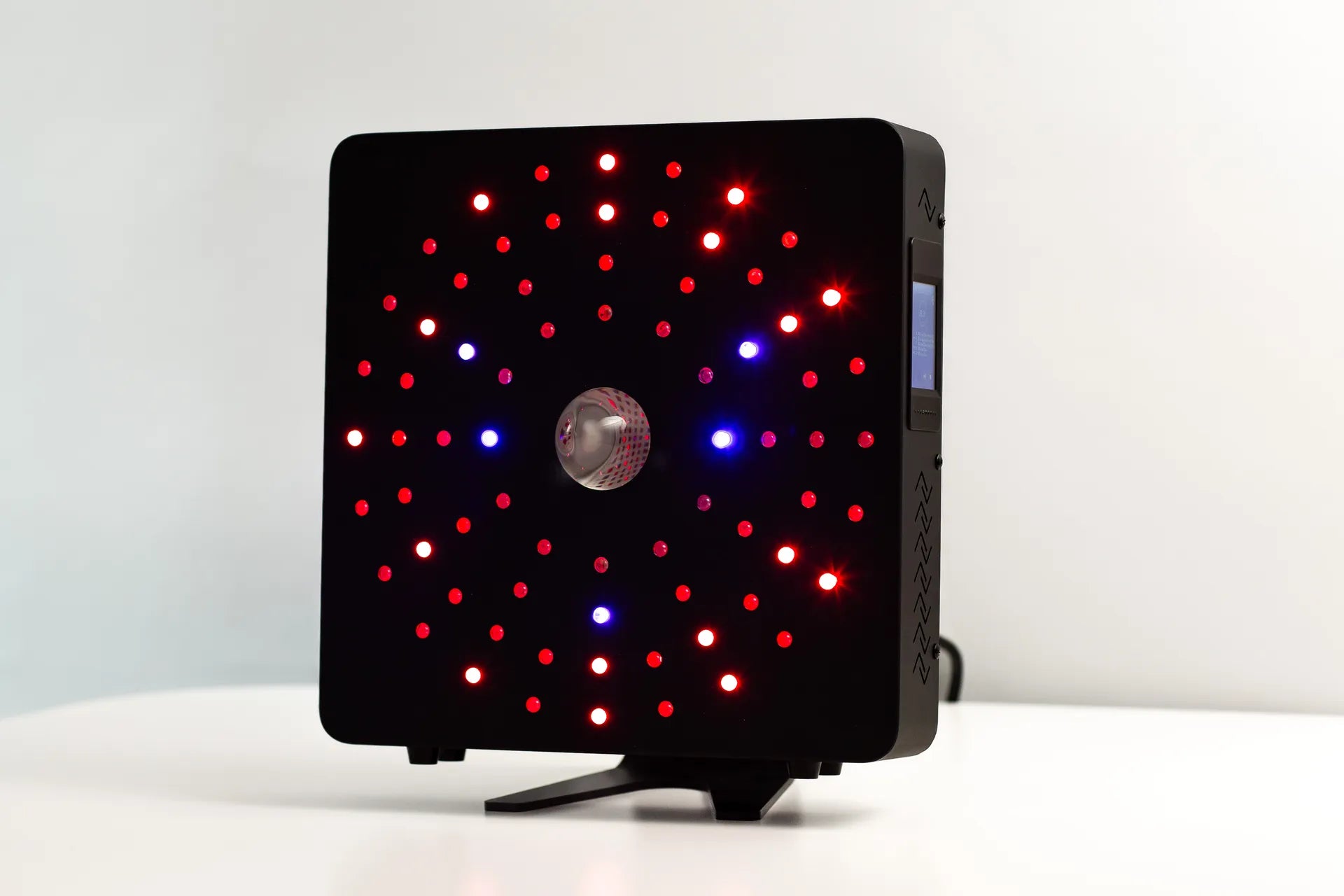
This is precisely why REDelios ONE places measured bands at 297nm (UVB) and 365/380nm (UVA) alongside its red and near-infrared — not to tan, but to restore the front of the spectrum that red+NIR devices structurally skip, in time-limited, controlled doses, the way a bright morning does. "Is all UV bad?" No — uncontrolled UV is dangerous, and measured, well-timed UV carries signals nothing else replaces. Owning that nuance honestly is the territory no red-only competitor occupies.
05 · Side By SideUV by band: harm and benefit live on the same dial
| Band | At the wrong dose | At the right, brief dose |
|---|---|---|
| UVB (~297nm) | Sunburn, DNA damage, cancer risk (IARC 2012; Pfeifer 2020) | The only band that makes vitamin D (MacLaughlin et al., 1982) |
| UVA (~365nm) | Deep dermal photoaging, MMP-driven collagen loss (Pittayapruek 2016) | Releases nitric oxide → vasodilation (Liu et al., 2014) |
| Deep UVA (~380nm) | Part of cumulative UV load | Read by OPN5 photoreceptor; circadian / ocular signalling (Kojima 2011) |
The same band sits on both sides of the dial — the dose makes the difference.
The UV bands in a full-spectrum device are intended for measured, time-limited, controlled doses — never to tan and never to burn. Brief and well-timed is the point; more is not better. If you are pregnant, photosensitive, taking photosensitising medication, or managing a skin or autoimmune condition, speak with a qualified professional before adding any UV-containing light to your routine. This is wellness and educational information, not medical advice.
REDLIGHT.DOCTOR provides wellness and educational information, not medical advice, diagnosis or treatment. Wavelengths and device specifications are stated as engineered. Studies referenced describe research findings and are not claims that any device treats, cures or prevents disease. Consult a qualified professional for individual guidance.