Red Light for Wrinkles: What the Collagen Studies Actually Show
Does red light really soften fine lines? Here is what the controlled collagen trials actually found, which wavelengths matter — and an honest week-by-week timeline.

Yes — for fine lines and skin firmness, the evidence is genuinely some of the strongest in the field. Controlled trials show red and near-infrared light increases collagen and reduces fine lines, working by stimulating fibroblasts and lowering collagen-degrading enzymes. But it's gradual: expect a glow in ~2 weeks, firmness over 8–12.
Of all the things red light is sold for, wrinkles is the one where the evidence is genuinely strong. This isn't a hopeful extrapolation from a petri dish — there are controlled human trials, with blinded measurements, showing real changes in collagen and fine lines. So we can be specific, and we can be honest about the timeline.
The honest version has two halves. First, what the collagen studies actually measured. Second, how long it really takes — because the gap between a two-week glow and genuine firmness is exactly where expectations go wrong.
01 · The EvidenceWhat do the collagen studies actually show?
This is one of the better-evidenced uses of red light, so we can name the trials. In a controlled study of 136 people, polychromatic red and near-infrared light significantly increased intradermal collagen density and reduced fine lines, with blinded before/after profilometry confirming the change (Wunsch & Matuschka, 2014). A separate mechanistic study found that 660nm LED light raised type-I procollagen by roughly 31% and lowered MMP-1 — a collagen-degrading enzyme — by about 18%, with clinically reduced wrinkles (Barolet et al., 2009).
The direction is consistent across the literature: more collagen made, less collagen broken down. A broader review of photobiomodulation in skin reaches the same conclusion — red and near-infrared light stimulates fibroblast proliferation, collagen synthesis and tissue repair (Avci et al., 2013).
| Study | Design | What it found |
|---|---|---|
| Wunsch & Matuschka, 2014 | Controlled trial, 136 subjects | ↑ intradermal collagen density, ↓ fine lines, improved skin texture |
| Barolet et al., 2009 | Mechanistic + clinical, 660nm | ↑ type-I procollagen ~31%, ↓ MMP-1 ~18%, reduced wrinkles |
| Avci et al., 2013 | Review of PBM in skin | Red/NIR stimulates fibroblast proliferation, collagen synthesis, repair |
Honest calibration: the Wunsch & Matuschka and Barolet trials are graded B in our library — strong, useful, real-world evidence (polychromatic and industry-adjacent), but not the same tier as a large independent RCT. We grade rather than oversell. Every study is in the research library.
02 · The MechanismHow does light build collagen?
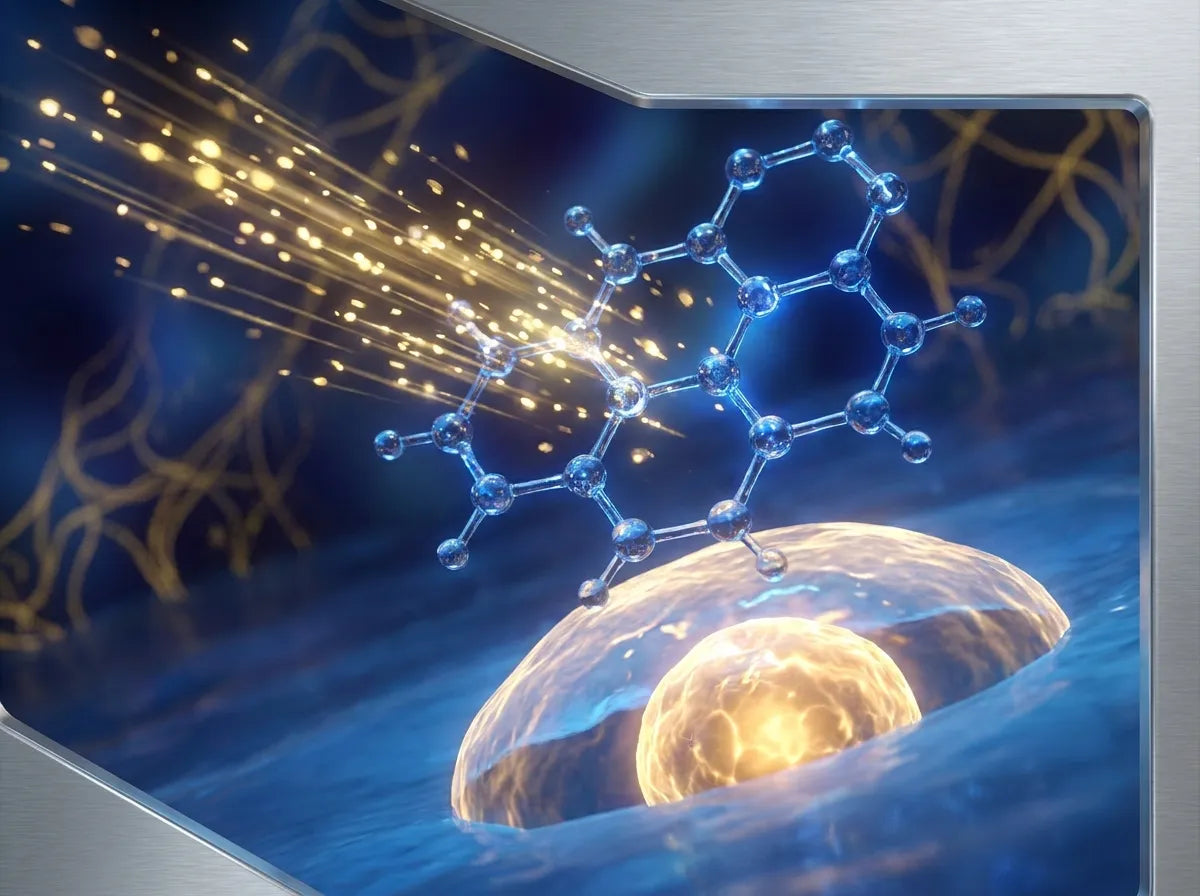
The mechanism connects to the same pathway behind red light's other effects. Red (~630–660nm) and near-infrared light is absorbed by cytochrome c oxidase in skin-cell mitochondria, supporting ATP production and the signalling that drives fibroblasts — the cells that manufacture collagen and elastin — to proliferate and produce more matrix (Karu & Kolyakov, 2005; Avci et al., 2013). At the same time, the studies above show it down-regulates MMP-1, the enzyme that breaks collagen down. More production, less degradation — the two levers that decide skin firmness.
Red light works two levers at once: it tells fibroblasts to build more collagen, and it quiets the enzyme that breaks collagen down. That is why the firmness is real — and why it takes time.
03 · WavelengthsWhich wavelengths matter for skin?
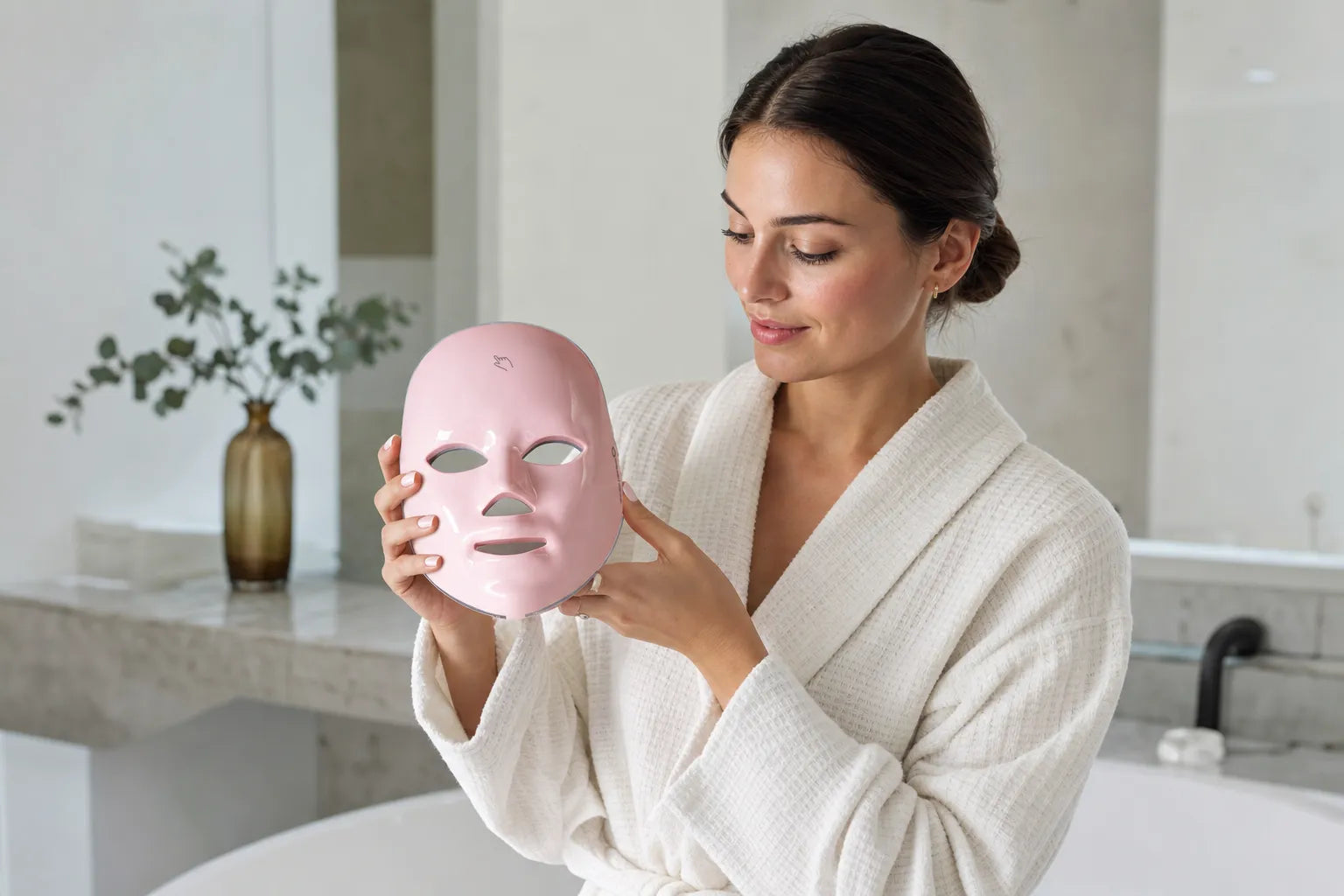
For collagen and tone, the well-studied bands are red around 630–660nm (surface, collagen) and near-infrared around 810nm (deeper, repair). Some skin devices add ~405nm violet for surface clarity. Our redPINK LED face mask combines 405 · 630 · 660 · 810nm — covering surface clarity, the two collagen-relevant red bands, and a near-infrared band — which maps directly onto the wavelengths the skin research points to. At €308 it is the focused, skin-first tool in the range.
04 · The TimelineHow long until you actually see a difference?
This is where expectations go wrong. Collagen remodelling is biology, not a filter — it takes time, and consistency beats intensity (the dose is biphasic; more per session isn't better — Huang et al., 2009). A realistic, non-medical timeline:
| Timeframe | What's realistic |
|---|---|
| ~2 weeks | A "glow" — improved tone, hydration, surface radiance |
| 4–6 weeks | Smoother texture; fine lines start to soften |
| 8–12 weeks | Firmness and fine-line improvement become visible — the collagen window |
| Ongoing | Maintained by continued regular use, not banked permanently |
If you're promised dramatic wrinkle erasure in days, be sceptical — that's not what the collagen science describes.
05 · Honest LimitsWhat red light for wrinkles is not
A few honest limits. Red light is not a filler or a resurfacing laser — it works gradually through your own collagen, not by removing tissue. It does not replace sun protection: UV is the dominant driver of skin photoaging via collagen-degrading MMPs (Pittayapruek et al., 2016), so protecting skin from excess UV does as much for wrinkles as any device. And it is wellness, not medical treatment.
06 · The Bigger PictureSkin lives under a whole spectrum
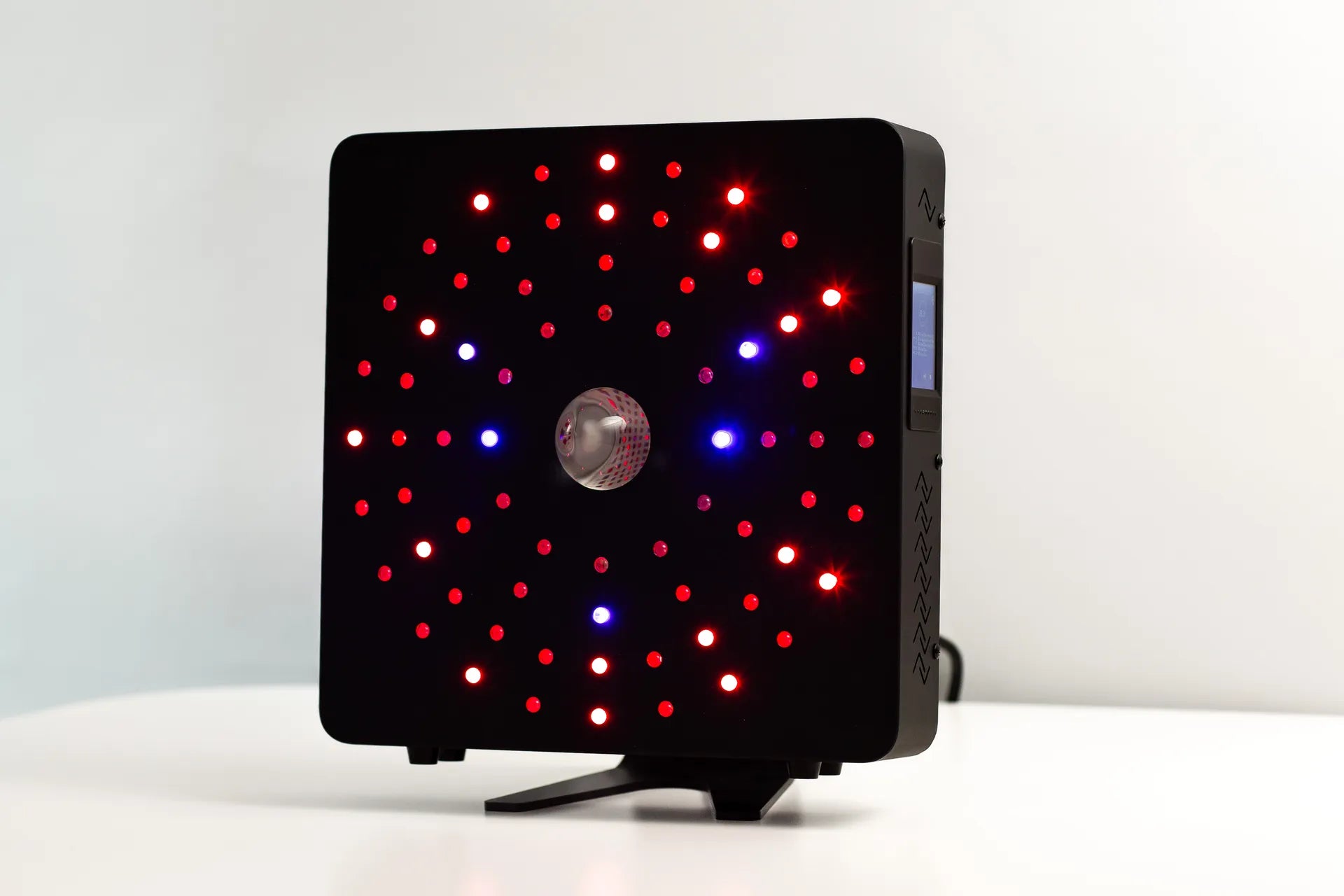
Here's the frame worth keeping. Red light builds collagen — genuinely, on the evidence above. But skin didn't evolve under a red panel; it evolved under the whole daily light environment, and its health reflects the full signal, not one band. The same sun that ages skin through unguarded UV also drives vitamin D, nitric oxide and the circadian rhythm that skin cells themselves keep time to (Plikus et al., 2015). A red-only mask gives you the collagen band; it stays silent on the rest. That's not a knock on red light for wrinkles — it works — it's the reason our full-spectrum thinking (REDelios ONE, 297–1280nm) treats skin as something living under a spectrum on a rhythm, with the collagen bands as one important part of a larger picture.
This is wellness and educational information, not medical advice. Red light supports the conditions for healthy skin; it does not treat, cure or prevent any skin condition. If you have a skin condition, are pregnant, or use photosensitising medication, speak with a qualified professional before starting. Protecting skin from excess UV remains the single biggest thing you can do for fine lines.
REDLIGHT.DOCTOR provides wellness and educational information, not medical advice, diagnosis or treatment. Wavelengths and device specifications are stated as engineered. Studies referenced describe research findings and are not claims that any device treats, cures or prevents disease. Consult a qualified professional for individual guidance.