Red Light Dosage: How Many Joules, How Long, How Often
How to dose red light therapy properly — what a joule (J/cm²) is, how irradiance and distance change everything, why more isn't better, and a starting-point table.
Dose is energy per area — joules per cm² (J/cm²) — and it equals irradiance (mW/cm²) multiplied by time. Most skin and recovery research lands around 3–10 J/cm² at the tissue, often a few minutes per area. The catch: red light is biphasic, so more is not better. Distance, time and wavelength decide your dose.
"Ten minutes" is the most common — and most useless — answer in red-light therapy. It tells you nothing, because minutes are not a dose. A dose is energy, and energy depends on how bright the light is at your skin and how long you sit there. Once you understand that one relationship, every "how long, how far, how often" question answers itself.
The good news is the arithmetic is simple and worth learning once. The rest of this piece walks through it — what a joule is, why more is not better, how distance changes everything, and a starting-point table you can actually use.
01 · The UnitWhat is a "joule" of red light, exactly?
A joule per square centimetre (J/cm², also called fluence or dose) is simply how much light energy lands on each patch of skin. It is the product of two things: how bright the light is at your skin — irradiance, measured in milliwatts per cm² (mW/cm²) — and how long you sit there, in seconds. The arithmetic is the whole game:
Dose (J/cm²) = Irradiance (mW/cm²) ÷ 1000 × Time (seconds)
So a panel delivering 100 mW/cm² at your treatment distance reaches roughly 6 J/cm² in one minute (100 ÷ 1000 × 60 = 6). Double the time, double the dose; halve the brightness, halve the dose. This is why "10 minutes" tells you almost nothing on its own — without irradiance, minutes don't convert to a dose. Our dose calculator does this maths for you; the glossary defines each term.
02 · The CurveWhy isn't more always better? (the biphasic rule)
This is the single most important — and most ignored — fact in light dosing. Photobiomodulation follows a biphasic dose–response: response rises with dose up to an optimum, then flattens and can fall if you keep going (Huang, Chen, Carroll & Hamblin, Dose-Response, 2009, PMID 20011653; updated in Huang et al., Dose-Response, 2011, PMID 22461763). It is a curve with a peak, not a ladder. Stacking on extra minutes past the optimum doesn't add benefit and can quietly undo it. The practical translation: find the effective window and stay in it. Start conservative, be consistent, and resist the instinct that a longer session is a better one.
03 · DistanceHow does distance change the dose? (more than you think)
Irradiance falls off fast as you move away from a panel — roughly following the inverse-square law (classical photometry; in our research library as a foundational principle). Move twice as far away and the light hitting your skin drops to about a quarter, not a half. That single fact resolves most "am I doing it right?" confusion:
What matters is that you know your device's irradiance at the distance you actually use, because a "surface" or total-wattage number measured at the LED face is marketing, not dose (see the buying guide). Light also penetrates tissue differently by wavelength — near-infrared (~810nm) reaches deeper than red (~660nm) (Anderson & Parrish, J Invest Dermatol, 1981, PMID 7252245; Salehpour et al., Photobiomodul Photomed Laser Surg, 2019, PMID 31553265) — so the "right" dose also depends on whether your target is skin-surface or deeper muscle and joint.
04 · Time & FrequencyHow long should a session be, and how often?
Once you accept that minutes are just dose ÷ irradiance, session length stops being a fixed rule and becomes a calculation. As general, non-medical starting points drawn from the dosing literature:
| Goal | Typical tissue dose | Rough session | Frequency |
|---|---|---|---|
| Skin — tone & fine lines | ~3–6 J/cm² (surface) | ~2–10 min/area | Most days; results build over weeks |
| Muscle recovery / performance | ~6–10+ J/cm² (deeper) | ~5–15 min/area | Around training; daily is fine within dose |
| Joints / deeper aches | higher end, NIR-led | ~8–15 min/area | Daily, consistent |
| General "indoor sun" / circadian | timing matters as much as dose | per device protocol | Daily, light by day |
Starting-point ranges, not prescriptions — your real numbers depend on your device's measured irradiance at your distance.
These are ranges, not prescriptions — your real numbers depend on your device's measured irradiance at your distance, which is exactly why we built the dose calculator and publish ready-made protocols per goal rather than a single blanket time.
05 · ResultsHow soon will I see results, and does it need to be ongoing?
Light dosing rewards consistency over intensity — the same way a daily dose of morning sun does more than one long blast. Skin changes (glow, tone) often show over roughly 2 weeks, firmness over 8–12 weeks; recovery and energy benefits compound with regular use. Benefits are generally maintained by ongoing use rather than banked permanently. A device you use most days at a correct dose beats a more powerful one you use occasionally and overdo.
06 · LimitsCan you overdo it? Signs and sensible limits
Side effects are uncommon and usually mild — transient warmth, redness, occasionally a light headache — and typically settle within an hour. Because the response is biphasic, "more" is not the fix if results stall; if anything, trimming back toward the optimal window is. Start short, build a habit, use eye protection, and treat dose as something to calibrate, not maximise. This is wellness information, not medical advice: if you are pregnant, photosensitive, on photosensitising medication, or managing a skin or autoimmune condition, speak with a qualified professional first.
07 · The Bigger FrameDose is only half of "the dose"
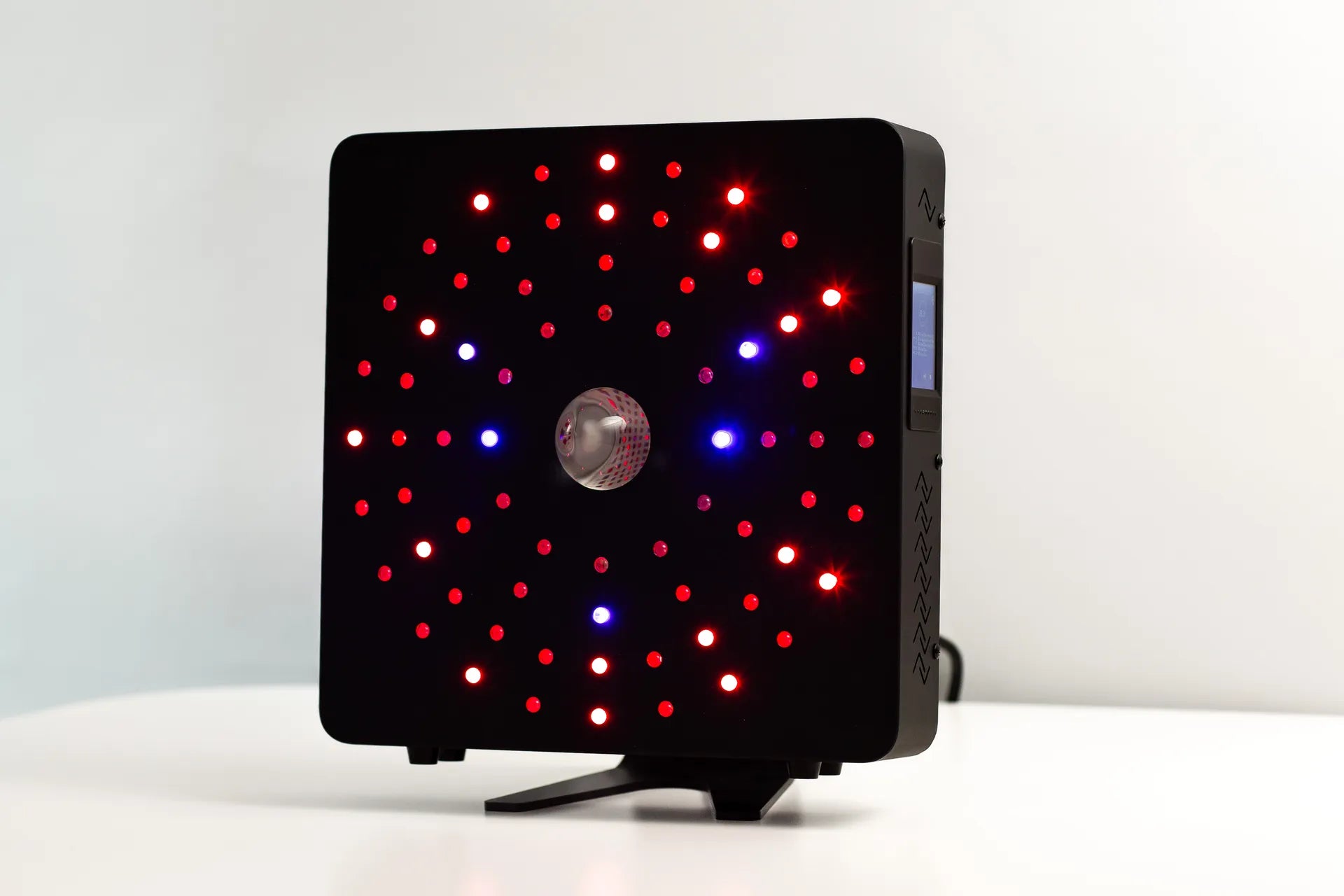
Here's the part the joules-and-minutes debate misses. For an isolated red/NIR panel, dose is the whole conversation — wavelength, irradiance, distance, time. But the sun never delivers a fixed dose in a dark room; it delivers a changing dose across the day, on a rhythm. Bright and full-spectrum in the morning, warm and low by evening. Real light dosing has two axes: how much (J/cm²) and when (timing). A red panel optimises the first and ignores the second entirely. A full-spectrum device like REDelios ONE is built to address both — the right wavelengths in measured doses, presented on a daily rhythm the way a bright morning does. Get the joules right; then remember the sun also keeps time.
Treat dose as something to calibrate, not chase. Start short, stay consistent, and use eye protection. Because the response is biphasic, a longer session is not a better one — if results stall, trim back toward the effective window rather than adding minutes. If you are pregnant, photosensitive, taking photosensitising medication or managing a skin or autoimmune condition, speak with a qualified professional before starting.
REDLIGHT.DOCTOR provides wellness and educational information, not medical advice, diagnosis or treatment. Dose ranges are general starting points, not prescriptions; your device's measured irradiance at your distance sets your real numbers. Studies referenced describe research findings and are not claims that any device treats, cures or prevents disease. Consult a qualified professional for individual guidance.